
The Visual Music Color System — How It Works and Why the Colors Are Not Arbitrary
When people first see Musical Colors® sticker guides on an instrument, the reaction is often curiosity about why specific colors are assigned to specific notes. It doesn't feel random — and it isn't. The color-to-note assignments in the Musical Colors® system are grounded in a real mathematical relationship between the frequencies of audible sound and the wavelengths of visible light.
Michael John Wiley, the founder of Musical Colors®, developed the system in Tucson, Arizona beginning in 1991. The core insight is that both music and light organize themselves into the same proportional structure — seven fundamental units that cycle and repeat through octaves. This makes a systematic, non-arbitrary mapping between the two possible.
The Mathematical Foundation — Sound Frequencies and Light Wavelengths
The Science page covers the full mathematical treatment, but the core principle is this: audible tone frequencies between 360Hz and 720Hz can be transposed upward by applying the Law of Octaves until they fall within the range of visible color frequencies. At that point, each musical note corresponds to a specific point in the visible light spectrum.
The Musical Colors® frequency-to-color formula:
AF (Hz) × 2ⁿ = VF (THz) → Color wavelength (nm)
Where AF = audible frequency, VF = visual frequency, and n = number of octave transpositions required to reach the visible light range.
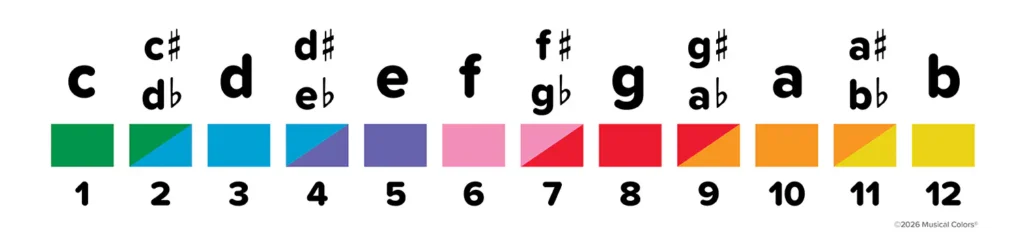
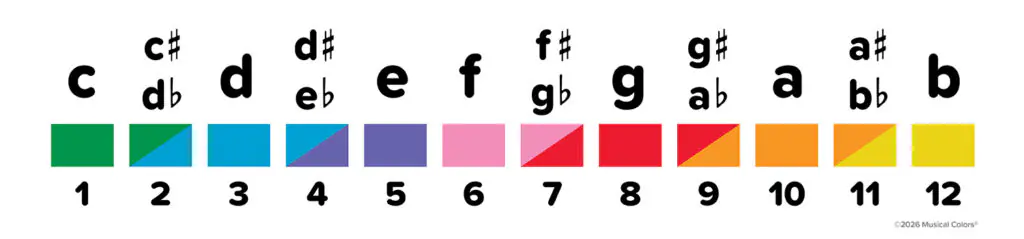
The result is that the seven natural notes in Western music — C, D, E, F, G, A, B — map to the seven colors of the visible spectrum in a consistent, mathematically grounded sequence. It's the same proportional relationship that Newton documented when he identified seven colors in the visible spectrum, and the same one that governs why both systems repeat in octaves.
All 12 Notes — Colors and Their Logic
Seven natural notes carry the seven spectrum colors. Five sharps and flats — the enharmonic notes that fall between natural notes — carry diagonal split-colors combining the two adjacent natural note colors. This visually communicates their in-between position in the note sequence.
The full note reference, including how colors relate to the 12 musical notes, is available on the Notes page.
Why It Works for Learning — Not Just for Looking Good
A color system that looks visually appealing but doesn't have consistent internal logic wouldn't hold up to extended use. The reason Musical Colors® works as a learning tool is that the color assignments are consistent across every octave, every string, every key, and every instrument. C is always red. G is always teal. Once you learn the color of a note, that knowledge is permanent and transferable.
The same note always carries the same color — on a guitar, on a piano, on a violin, on a ukulele. A student who learns to see G as teal on a ukulele in second grade can pick up a guitar ten years later and immediately recognize teal as G on the fretboard without starting over.
What This Means for Music Theory
Color makes music theory visible in a way that notation on paper doesn't. When a scale is displayed as a color pattern, the relationships between notes become observable directly on the instrument. A major scale is a recognizable color sequence. A chord built from that scale uses specific colors from that sequence. The intervals and relationships that take months to understand from charts can be seen in minutes on a color-coded instrument.
Color, the Circle of Fifths, and Scale Relationships
The scales page covers color-coded scales in detail. The Playground membership includes 150+ color-coded scales and chords, an interactive Circle of Fifths, and modulation tools — all built on the same consistent color system. For advanced players and composers, the visual system becomes a genuine compositional tool rather than just a learning aid.
Further Reading — Color System and Science
The System page gives a practical overview of how the sticker guides are installed and used, while the Optics page addresses accessibility for musicians with different types of color vision.
Frequently Asked Questions — The Color System
How does Musical Colors® assign colors to musical notes?
The Musical Colors® system is grounded in the mathematical relationship between audible sound frequencies and visible light wavelengths. By applying the Law of Octaves — transposing audible frequencies upward until they fall within the visible light spectrum — each of the 12 musical notes can be matched to a corresponding color on the spectrum. The seven natural notes map to the seven spectrum colors. The five sharps and flats receive diagonal split-colors combining their two adjacent natural note colors. See the full science page →
Why exactly 7 colors for the 7 natural notes?
The seven natural notes in Western music and the seven colors of the visible spectrum share the same underlying mathematical structure — both organize into seven fundamental units that repeat in octaves. This is not a coincidence; it reflects a genuine proportional relationship. Newton identified seven colors in the visible spectrum partly because he was aware of the seven-note musical analogy. Musical Colors® founder Michael John Wiley documented this relationship formally beginning in 1991.
Does the color system work for musicians with color blindness?
Musical Colors® acknowledges that standard color vision is not universal and is actively developing accessible alternate versions for musicians with different types of color vision — including Protanopia, Deuteranopia, Tritanopia, and Achromatopsia. The Optics page covers the current status of accessible product development and how to get involved or stay informed.
Does the same color always mean the same note on every instrument?
Yes — and this consistency is what makes the system genuinely transferable. C is always red on a guitar, piano, violin, ukulele, banjo, mandolin, and percussion instrument. The color assignments never change based on instrument, string, key, or octave. This means knowledge built on one instrument carries directly to any other Musical Colors® instrument without relearning the color system.